
Tiny measurement errors can turn an expensive part into scrap within seconds. Modern manufacturing avoids those mistakes through machine engineering, software control, and highly refined machining systems working together at the same time. Precision in CNC machining comes from far more than computer automation alone.
Machine Tool Rigidity and Mechanical Stability
Heavy machine frames help reduce vibration during cutting. Cast iron bases, reinforced structures, and stable machine geometry allow the equipment to stay steady while removing material at high speeds. Without rigidity, the cutting tool can shift slightly under pressure, causing uneven dimensions or poor surface finishes.
Industrial CNC machining systems are designed to resist movement while under load. Stronger machine construction also improves repeatability during long production runs because the spindle and worktable maintain consistent alignment. Businesses searching for CNC companies near me often overlook how much machine stability affects final part quality.
High-Resolution Feedback and Closed-Loop Control Systems
Modern CNC equipment constantly checks its own movement while machining. Feedback systems use sensors and encoders to monitor position changes down to extremely small increments, then send correction data back to the control system in real time.
Closed-loop controls help machines detect motion differences before they become visible errors. If the machine falls slightly behind the programmed path, the system automatically adjusts movement to stay accurate. A CNC machine company using advanced feedback technology can maintain tighter tolerances during both simple and highly detailed operations.
Precision Ball Screws and Linear Guides
Machine movement depends heavily on the hardware responsible for axis travel. Precision ball screws convert motor rotation into smooth linear motion while reducing friction and backlash that could affect positioning accuracy.
Linear guides also help support stable movement across the machine axes. High-quality guide systems allow the spindle and table to travel smoothly without unwanted side motion or vibration. Reliable CNC machining depends on these mechanical components remaining consistent under continuous production loads.
Computer-Controlled G-code and M-code Execution
CNC machines follow digital instructions line by line during production. G-code controls cutting movement, positioning, feed rates, and interpolation, while M-code manages spindle functions, coolant systems, and tool changes.
Automated code execution removes much of the inconsistency associated with manual operation. Programmed movements allow identical cuts to repeat with high accuracy across large batches of parts. Many CNC companies near me rely on optimized code structures to improve both production speed and dimensional consistency.
Automated Toolpath Optimization via CAD/CAM Software
Modern CAD/CAM software calculates highly efficient cutting paths before machining begins. These systems analyze part geometry, material type, cutting strategy, and tool selection to create smoother machine movement throughout production.
Advanced software also helps reduce sudden direction changes that may create vibration or tool stress. Better toolpaths improve surface finish while lowering unnecessary wear on the cutting equipment. A CNC machine company using updated CAM systems can often reduce production time without sacrificing part quality.
Advanced Thermal Expansion Compensation
Heat affects machining accuracy more than many people realize. Spindles, cutting tools, and machine structures naturally expand slightly as temperatures rise during production.
Thermal compensation systems help account for those changes automatically. Sensors monitor temperature conditions and adjust machine positioning to maintain dimensional accuracy throughout the machining cycle. Precision CNC machining often depends on controlling these small thermal shifts, especially during long production runs or tight-tolerance work.
High-Quality Spindle and Cutting Tool Selection
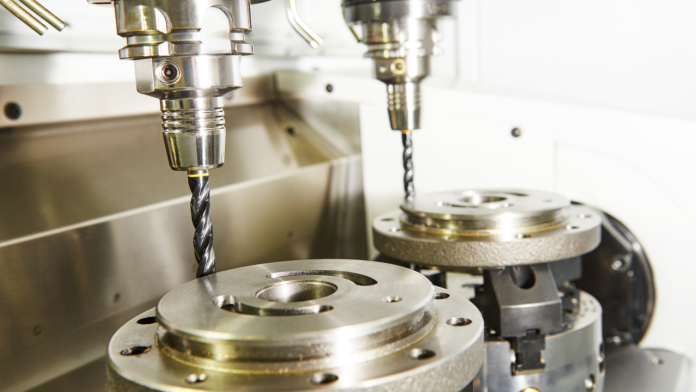
The spindle serves as the heart of the machine because it controls rotational accuracy during cutting. Poor spindle quality can create vibration, inconsistent finishes, and unstable tool movement even if the rest of the machine performs well.
Cutting tools also play a major role in machining precision. Tool geometry, coating type, sharpness, and material compatibility all influence final results. Skilled machinists select tooling based on material hardness, feed rates, and finish requirements rather than relying on generic setups for every project.
Rigorous Workholding and Fixturing Stability
Accurate machining becomes impossible if the workpiece shifts during production. Workholding systems secure the material firmly while allowing the machine to reach the necessary cutting areas safely and consistently.
Custom fixtures are often designed specifically for difficult part geometries or tight-tolerance applications. Strong fixturing helps reduce vibration while maintaining stable positioning throughout the machining cycle. Companies evaluating CNC companies near me often focus on machine size or speed, but fixturing quality directly affects repeatable accuracy as well.
Reliable manufacturing precision comes from the combination of stable machinery, advanced programming, quality tooling, and experienced process control. Amtec Solutions Group supports CNC machining projects with systems and production methods built around accuracy, repeatability, and dependable machining performance across demanding industrial applications.