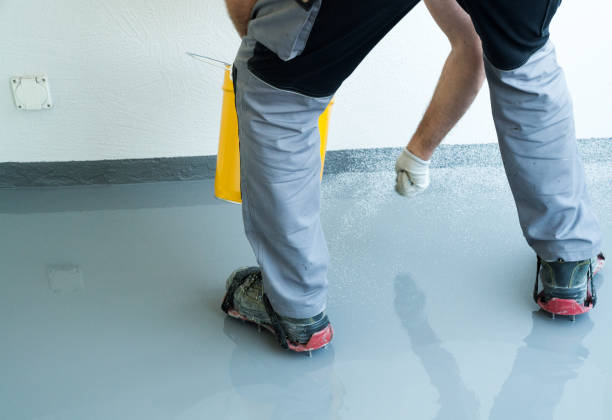

Early coating failure often points to problems beneath the finished surface rather than a defect in the epoxy itself. Proper preparation gives resin a clean, textured base that can support vehicle traffic, heat, moisture, and impact. Several visible warning signs can reveal that an epoxy garage floor was applied too quickly or over unsuitable concrete.
Peeling Around Tires and High-Traffic Areas
Peeling near parked vehicles often suggests that the coating never formed a strong mechanical bond with the slab. Hot tires soften weakly attached material, while turning wheels place sideways pressure on the finish. Once an edge lifts, dirt and moisture can travel beneath it and enlarge the damaged area.
Bare concrete under the peeled section provides another clue. A smooth or shiny surface may indicate that installers skipped diamond grinding or shot blasting. Properly prepared concrete should have a light, even texture that allows epoxy flooring to enter small pores and harden around the surface profile.
Bubbles and Blisters Beneath the Coating
Raised bubbles may form when moisture vapor, trapped air, or contamination pushes against the underside of the coating. Moisture-related blisters often appear in several areas rather than around one spill or impact point.
Warning signs connected with vapor pressure include:
- Rounded bubbles that return after repair
- Dark concrete beneath loose coating
- White mineral deposits near cracks
- Blistering close to exterior walls
- Dampness under stored mats or cabinets
Reliable epoxy floor companies test the slab before installation because dry-looking concrete can still contain moisture. Skipping that step may leave a new floor vulnerable even when the surface appeared clean during application.
Flaking Along Edges, Corners, and Doorways
Perimeters frequently fail first when large grinding equipment cannot reach walls, steps, drains, or door tracks. Hand grinders should prepare those tight sections so the coating bonds as securely at the edges as it does across the center.
Thin, brittle strips near the garage entrance may also show that dust remained after grinding. Wind and foot traffic collect debris around openings, making detailed vacuuming especially important. Homeowners searching for an epoxy garage floor near me should ask how the crew handles edges rather than assuming one machine prepares the entire slab.
Visible Scratches Beneath a Thin Finish
Grinding marks should not remain obvious after a properly specified coating system cures. Deep lines showing through the finished floor may mean the surface profile was too aggressive for the coating thickness, or the installer spread the material below its required coverage rate.
Uneven film build can create several noticeable defects:
- Dark or light roller lines
- Rough patches beside smooth sections
- Bare peaks in textured concrete
- Different gloss levels across the floor
- Flake coverage that fails to hide repairs
Professional epoxy floors use measured application rates for each layer. Guessing coverage by appearance can leave weak areas with less protection against abrasion and chemicals.
Soft, Sticky, or Rubbery Sections
Soft spots usually point to incorrect mixing, inaccurate resin-to-hardener ratios, or material that exceeded its working time. Unmixed product can collect along container walls and reach the slab if installers fail to transfer or blend each batch carefully.
Temperature also affects curing. Cold concrete slows the chemical reaction, while high humidity can create condensation that disrupts adhesion. Contractors offering commercial epoxy flooring should monitor air temperature, slab temperature, humidity, and dew point before and during application.
Cracks Reappearing Through the Surface
Concrete movement can reopen cracks, but quick reappearance may show that the installer coated over damage without proper repair. Smearing epoxy across the top rarely provides enough depth or strength to stabilize the area.
Correct treatment depends on whether the crack is dormant, active, structural, or moisture-related. Specialists should clean the opening, remove fragile edges, apply a compatible repair material, and grind the patch level before coating. People comparing epoxy floors near me should ask how cracks and control joints will be handled separately.
Coating That Lifts in Large Sheets
Large sheets of loose flooring suggest widespread adhesion failure rather than isolated impact damage. Sealers, curing compounds, dust, oil, or weak cement paste may have remained between the resin and slab.
Inspection of the exposed underside can reveal likely causes. Powdery residue often points to laitance or grinding dust, while a clean, glossy concrete surface suggests insufficient profiling. Oily discoloration may show contamination that mechanical preparation failed to remove completely.
Uneven Flake Coverage and Patchy Color
Decorative flakes should appear balanced across the floor without bare areas, heavy piles, or obvious lines between batches. Patchy coverage may reflect rushed broadcasting, inconsistent base-coat thickness, or epoxy that began curing before the flakes were applied.
Color variation can also develop when batches are mixed at different ratios or spread outside their working window. Although appearance alone does not prove poor adhesion, irregular placement often signals weak control during other parts of the installation.
Premature Chipping Under Normal Use
Chips caused by ordinary parking, rolling storage cabinets, or light tool drops can indicate a coating that is too thin for the space. Poor bonding makes the problem worse because impact catches weak edges and removes larger pieces.
Durable epoxy flooring requires the full system to match expected use, including primer, body coat, decorative material, and protective topcoat. Searches for epoxy flooring near me should focus on written system details rather than color samples alone.
A Strong Floor Begins With Work That Cannot Be Seen
Surface grinding, moisture testing, crack repair, dust removal, and environmental checks disappear beneath the finished coating, yet they determine how long the floor remains attached. Elite Coastal Epoxy prepares residential garages and commercial or industrial slabs before installing each system, helping property owners avoid the peeling, bubbling, and premature wear associated with rushed epoxy garage floor applications.